Doors play a central role in accessibility. The Americans with Disabilities Act (ADA) sets detailed requirements for how doors must be designed, installed, and maintained so people with disabilities can use them without barriers. One of the most critical elements of this design is ADA door approach clearances—the space around doors that allows for safe and independent operation, whether the door swings inward, outward, or slides.
For inspectors, facility managers, and builders, understanding these clearances is essential for ensuring compliance and avoiding costly violations. But ADA door standards go beyond clearances: factors like door swing, maneuvering room, hardware, and door height all contribute to accessibility.
This guide breaks down everything you need to know, from the ADA standard for doors to practical inspection steps using tools like the ADA Inspection Tool Kit. Whether you’re new to accessibility inspections or refining your compliance knowledge, you’ll walk away with actionable insights.
What Is the ADA Standard for Doors?
Defining ADA Door Standards
The ADA establishes minimum standards to ensure doors are usable by individuals with mobility impairments. These include width, height, hardware, opening force, and maneuvering clearances.
- Minimum clear width: 32 inches when the door is open 90 degrees.
- Maximum door thickness for clearances: 24 inches at latch side.
- Maximum threshold height: ½ inch beveled.
- Hardware requirements: Operable with one hand, no tight grasping/twisting.
- Door opening force: ≤ 5 pounds for interior hinged doors.
Why These Standards Matter
Without proper clearances, wheelchair users or those with mobility devices may not be able to approach or maneuver through a doorway safely.
Summary: ADA door standards set the foundation for accessible design by defining minimum width, height, force, and clearance rules.
What Are ADA Door Approach Clearances?
Definition
Approach clearance refers to the required floor space adjacent to a doorway that allows users to maneuver and operate the door.
Key Requirements
- Forward approach: Clear space of 48″ minimum depth and 60″ minimum width.
- Side approach: 60″ minimum length and 36″ minimum width.
- Pull side vs. push side: Clearances vary depending on swing direction.
Examples
- A wheelchair user approaching a restroom door from the pull side needs 60″ clear depth for turning.
- An automatic sliding door requires different clearance dimensions than a hinged swing door.
Summary: ADA door approach clearances ensure adequate maneuvering space on both push and pull sides, tailored to the door’s swing.
How Do ADA Door Swing Clearances Work?
Push Side Clearances
- At latch side: 12 inches minimum if front approach.
- Additional space needed for side approaches.
Pull Side Clearances
- At latch side: 18 inches minimum.
- Extra clearance required for doors with closer + latch.
Diagram Reference
Imagine a door opening outward toward the user: the clearance ensures that while pulling the door, there’s enough room for the wheelchair to maneuver.
Summary: ADA door swing clearances vary between push and pull sides, with greater space required on the pull side for safety and accessibility.
How to Measure ADA Door Maneuvering Clearances
Step 1: Identify Door Type
Hinged, sliding, or folding doors each have different clearance needs.
Step 2: Determine Approach Direction
Forward approach vs. side approach.
Step 3: Measure Required Width and Depth
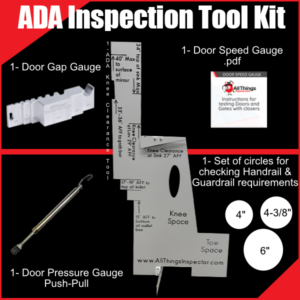
Use an ADA Inspection Tool Kit with a tape measure, angle gauge, and door pressure gauge.
Step 4: Confirm Swing Clearance
Check push and pull side separately.
Step 5: Record and Report Findings
Document compliance with photos and measurements.
Summary: Measuring ADA maneuvering clearances requires knowing the approach type, door swing, and precise measurements using inspection tools.
ADA Door Height and Parts You Need to Know
Door Height
- Minimum height clearance: 80 inches.
- Protruding objects above 27 inches must not reduce clearance.
Essential Door Parts for ADA Compliance
- Hardware: Lever handles preferred.
- Closers: Must not require excessive force.
- Thresholds: ½ inch beveled maximum.
- Vision lights: Positioned between 43–66 inches.
Summary: ADA door compliance includes not only clearances but also parts like handles, closers, and thresholds that affect usability.
Why Are ADA Door Maneuvering Clearances Important?
- Accessibility: Enables independence for wheelchair users.
- Safety: Prevents accidents due to tight maneuvering.
- Legal compliance: Reduces risk of lawsuits or penalties.
- Universal design: Benefits everyone, including parents with strollers.
Summary: ADA door maneuvering clearances are important for safety, usability, and compliance—making them a core part of accessible design.
Common ADA Door Compliance Mistakes to Avoid
- Installing hardware too high (>48 inches).
- Forgetting extra clearance on the pull side.
- Using thresholds over ½ inch.
- Failing to measure with proper tools.
- Overlooking door pressure (often exceeds 5 lbs).
Summary: Avoiding common mistakes ensures inspections catch real accessibility issues before they lead to violations.
FAQs
What is the ADA standard for doors?
ADA doors must be at least 32 inches wide, 80 inches high, with hardware usable by one hand and minimal opening force.
What are ADA door approach clearances?
They are required floor spaces around doors that allow wheelchair maneuvering depending on swing and approach.
How do I measure ADA door swing clearance?
Measure latch-side clearance separately for push and pull sides using an inspection toolkit.
What tools help with ADA door inspections?
An ADA Inspection Tool Kit with a door pressure gauge, measuring tape, and angle tools.
What is the minimum clearance on the pull side of a door?
Typically 18 inches at the latch side.
Are thresholds allowed under ADA standards?
Yes, but they must not exceed ½ inch in height and must be beveled.
Do automatic doors need the same clearances?
Automatic sliding doors follow different clearance standards, but approach space is still required.
How high can door hardware be?
Maximum 48 inches from the finished floor.
Q9: Can older buildings be exempt from ADA door standards?
Generally no—alterations and public access areas must comply unless technically infeasible.
Q10: Why do inspectors fail ADA door compliance checks?
Most failures come from improper latch-side clearances, high force requirements, and non-compliant hardware.
Conclusion
Ensuring ADA door approach clearances and related requirements are met is critical for creating accessible spaces. From swing clearances to maneuvering room, door parts, and inspection tools, compliance helps guarantee equal access and legal protection.
For inspectors, builders, and facility managers, understanding these details isn’t just about passing inspections—it’s about designing environments where everyone can move independently.
If you’re conducting inspections, consider using tools like the ADA Inspection Tool Kit available at All Things Inspector. This ensures your evaluations are accurate, efficient, and compliant with ADA standards.