
Creating accessible spaces is not only a legal duty—it’s a commitment to inclusion and safety. One essential part of that responsibility is building an ADA ramp that meets compliance standards and provides comfort for everyone, including wheelchair users and those with limited mobility.
This guide explains everything you need to know about ADA ramp requirements, design standards, slope ratios, and inspection best practices—so you can build or inspect with full confidence.
What Is an ADA Ramp and Why It Matters
An ADA ramp is a sloped pathway designed to provide an accessible route for individuals with disabilities. It ensures safe movement between levels where stairs would otherwise create a barrier. According to the 2010 ADA Standards for Accessible Design, a properly built ramp must offer smooth transitions, non-slip surfaces, and safe handrails.
For property owners, contractors, and inspectors, following these standards means more than avoiding penalties—it means upholding accessibility and universal design principles that benefit everyone.
Understanding ADA Ramp Requirements
The ADA ramp requirements define the physical dimensions and features every compliant ramp must have. They cover slope, rise, width, handrails, landings, and surfaces.
Here are the most essential criteria:
a. Slope and Rise
The maximum slope allowed is 1:12—that’s one inch of rise for every twelve inches of run. This ratio ensures manageable effort for wheelchair users.
For every rise of 30 inches, you need an intermediate landing to prevent fatigue and improve safety.
b. Width
Ramps must have a minimum clear width of 36 inches, providing enough space for users to maneuver comfortably. Wider ramps are encouraged when traffic is two-way or when users carry assistive devices.
c. Landings
Level landings must be provided at the top and bottom of each ramp. Each landing should measure at least 60 × 60 inches to allow a full turn of a wheelchair. Intermediate landings are also required for longer ramps or direction changes.
d. Handrails
Handrails are required on both sides if a ramp rises more than 6 inches or runs longer than 72 inches. They must be 34–38 inches in height and extend 12 inches beyond the top and bottom of the ramp for stability.
e. Surface & Edge Protection
Surfaces must be firm, stable, and slip-resistant. Edge protection (curbs or barriers) prevents wheelchairs from slipping off. A curb height of at least 2 inches is recommended.
When these design elements are applied correctly, the ramp becomes not just compliant, but comfortable and dignified to use.
ADA Ramp Slope Ratio Explained
The ADA ramp slope ratio determines how steep or gentle a ramp can be. This is the single most important factor in accessibility.
Rise (inches) | Run (inches) | Slope Ratio | Comment |
1 | 12 | 1:12 | Maximum allowed slope |
1 | 16 | 1:16 | Easier to climb, ideal for long ramps |
1 | 20 | 1:20 | Technically a “walkway,” not a ramp |
A ramp built to the 1:12 ratio offers balance between practicality and accessibility. However, wherever space allows, a gentler slope such as 1:16 provides greater ease of movement—especially for manual wheelchair users or elderly individuals.
How to Calculate ADA Ramp Dimensions
When planning a new ramp, the formula is simple:
Ramp Run = Rise × 12
For example, if you need to cover a height of 30 inches:
30 × 12 = 360 inches (30 feet) total run.
This calculation helps you plan how much space you’ll need, including landings and turns. Always verify your measurements on-site using accurate inspection tools such as a digital level or slope gauge.
Common Mistakes in ADA Ramp Design
Even experienced builders sometimes overlook small details that cause compliance failures. Here are frequent issues inspectors encounter:
- Excessive slope (too steep beyond 1:12)
- Uneven surfaces that create trip hazards
- Improper handrail height or extensions
- Missing edge protection
- Inadequate landings before doorways
- Blocked ramp approaches or cluttered access routes
Fixing these issues during the design phase saves both cost and legal risk later.
ADA Ramp Inspection Checklist
A well-structured ADA ramp inspection checklist ensures that every component meets legal and safety requirements. Below is a concise list inspectors often follow:
Inspection Item | Standard | Notes |
Ramp slope ratio | Max 1:12 | Measure both directions |
Clear width | Min 36″ | From handrail to handrail |
Handrail height | 34″–38″ | Must extend 12″ at ends |
Landings | 60″×60″ minimum | Level and clear |
Surface | Non-slip | Firm and stable |
Edge protection | ≥ 2″ curb | Both sides if drop present |
Transitions | Smooth | No more than ½″ rise |
Signage | Visible & clear | Indicates accessible route |
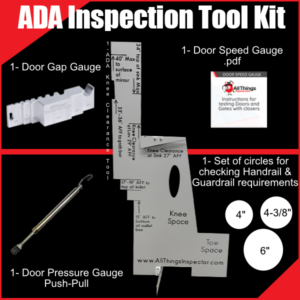
Inspectors should document each measurement, note deficiencies, and provide repair recommendations. At AllThingsInspector.com, professionals can find reliable ADA inspection tools—digital levels, slope gauges, and templates—to ensure every reading is accurate.
Maintenance and Retrofitting Older Ramps
Compliance doesn’t stop after construction. Regular maintenance keeps ramps safe and functional. Over time, environmental wear and surface erosion can make a once-compliant ramp unsafe.
Maintenance tips:
- Check non-slip coatings annually.
- Clean debris and ensure proper drainage.
- Repaint or replace handrails showing corrosion.
- Verify slope and surface integrity after repairs or earthquakes.
Retrofitting:
Older structures often need updates to meet current ADA standards. Adding landings, re-grading slopes, and installing new handrails can bring them into compliance. Small investments can prevent lawsuits and improve accessibility for decades.
Tools and Resources for ADA Ramp Inspection
Professionals and property owners alike rely on proper tools to ensure accurate measurements and compliance.
Recommended tools include:
- Digital slope meter – measures exact slope ratio.
- Measuring tape and level – verifies rise and run.
- Surface friction tester – checks slip resistance.
- ADA templates – ensure proper marking and alignment.
You can find all these tools on AllThingsInspector.com, a trusted source for inspection resources across the United States. The brand’s mission is to make compliance easy, consistent, and accurate for building professionals.
Local Codes and Variations
While the ADA sets federal standards, local jurisdictions may have stricter requirements. Always confirm with your city’s building department. For example:
- California Building Code (CBC) adds extra edge protection standards.
- Texas Accessibility Standards (TAS) require additional signage.
- Some cities have inspection frequency requirements for public ramps.
Understanding these variations ensures every project meets both ADA and local expectations.
Case Example: Correcting a Non-Compliant Ramp
A small retail store installed a ramp with a slope of 1:10, exceeding ADA limits. Customers found it difficult to navigate, and complaints followed.
After re-grading the ramp to a 1:12 slope, adding landings, and installing compliant handrails, the space passed inspection and improved accessibility.
This example shows that meeting ADA ramp requirements benefits both users and businesses—safer access means happier customers and fewer liabilities.
The Importance of Professional Inspections
An ADA ramp inspection is more than a box-checking exercise—it’s a safeguard for safety and accessibility. Professional inspectors verify details that untrained eyes may overlook.
By using the ADA ramp inspection checklist and reliable tools, inspectors ensure ramps meet all current standards. At AllThingsInspector.com, the focus is on empowering those inspectors and property owners with the right resources to perform precise, code-compliant evaluations.
Frequently Asked Questions
What is the maximum slope allowed for an ADA ramp?
The maximum slope is 1:12, meaning 1 inch of rise for every 12 inches of run.
Do all ramps require handrails?
Yes, if the ramp rises more than 6 inches or extends more than 72 inches. Both sides must have handrails.
How wide does an ADA ramp need to be?
The minimum clear width is 36 inches between handrails.
What are the key ADA ramp requirements?
Slope ratio, width, handrails, landings, and slip-resistant surfaces are required. Each must meet the 2010 ADA Standards.
How do inspectors measure ADA ramp slope ratio?
They use a digital level or slope gauge to calculate the rise-to-run ratio accurately.
Conclusion
An ADA ramp is more than a structure—it’s a promise of inclusion. Designing, inspecting, and maintaining ramps according to ADA ramp requirements ensures that everyone can enter, exit, and move through spaces safely and independently.
Whether you’re an architect, builder, or inspector, compliance starts with understanding the details—and ends with consistent verification.
At AllThingsInspector.com, you’ll find the inspection kits and digital tools that make ADA compliance easier, faster, and more precise.