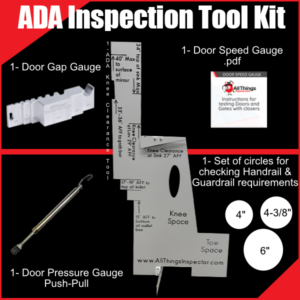
The Americans with Disabilities Act (ADA) presents specific guidelines so that all buildings become accessible to everyone, including the people with disabilities. A major aspect of these guidelines entails the opening pressure of the doors, which is also known as door pressure. It is crucial that the facility managers, contractors, and compliance officers have the understanding of the differences between the pressure requirements of interior and exterior doors.
Such an article will cover the ADA standards on door pressure and explain the main differences between interior and exterior door structures and why the ADA Door Pressure Gauge is needed to ensure an accurate measurement of the fixture and compliance.
Understanding ADA Door Pressure Requirements
ADA makes doors very usable by persons with disability without straining, grasping, pinching, curving the wrist. As far as pressure is concerned, the ADA targets the quantity of the force (in pounds) that it takes to open the door.
What is Door Pressure?
Door pressure is the quantity of force which is required to open the door to a certain angle, mostly 70 o. It is expressed in pounds force (lbf). Strong force may render wheelchair users or other people with poor strength unable or hard to have access.
ADA Standards: Interior vs. Exterior Doors
While the ADA provides guidelines for both, the standards differ based on whether the door is interior or outside because of environmental forces like the winds, the air pressure and the security.
1. Interior Doors
- Maximum Pressure of ADA Doors:
- It requires 5 lbf of force to open the door.
Applicability:
Covers all internal hinged doors, such as in bathrooms, offices, classrooms and during passage ways.
Rationale:
Interior doors as they are not impacted so much by the environment such as wind or temperature will be easy to open and require little force to open them.
2. Exterior Doors
ADA Specification:
ADA does not allot a certain maximum force to the exterior doors as these factors include the wind load, door seals or security requirements.
Best Practices:
As is not required, an industry typical external door pressure is 8.5 to 10 pounds of force. This is aimed at maintaining the pressure as minimal as possible devoid of security and environmental protection sealing.
Referenced Guidelines:
ADA does not enforce ANSI 117.1 and the IBC (International Building Code) that frequently specifies 15 pounds as a maximum weight on exterior doors.
Why the Difference?
External doors will also tend to be air, wind or water tight and can have a security locking system. Ms. Goal has added demands which naturally translate into an increased level of pressure which is absorbed according to the ADA guidelines to some degree.
Interior doors generally do not have such a sealing or security purpose, however, and the ADA is able to impose lower force limits to improve accessibility.
Measuring Door Pressure Accurately with an ADA Door Pressure Gauge
In order to comply, professionals employ the use of an ADA Door Pressure Gauge which is a basic mechanical device, which measures the precise amount of force necessary to open a door.
What is the ADA Door Pressure Gauge?
ADA Door Pressure Gauge (sometimes referred to as a door force gauge or a door force meter) is a hand-held gauge calibrated to respond in pounds of force. It is forced against the surface of the door and pushed or drawn when opening the door. The instrument is used to show the amount of force.
Benefits:
Assures ADA Compliance
Assists with verification of interior doors that exceeds 5 lbf avoiding violations, penalties and delays.
Enhances Accessibility
Provided capabilities of adjusting door closers and hinges to improve operation.
Fast and Easy
Most gauges provide instant readings and can be used by facility managers or building inspectors with very little training.
ADA Compliance Tips for Door Pressure
- Check door closer settings – Adjust door closers to provide the least amount of resistance and proper speed of closure.
- Lubricate hinges – Friction increases our opening force; well maintained hardware reduces pressure.
- Routine testing – A standard practice is to use an ADA Door Pressure Gauge as routine, especially in facilities used for many purposes or with ongoing renovations.
- Contact a professional – If a particular facility is large or the circumstances are ambiguous – an ADA compliance consultant or licensed contractor may be consulted.
Final Thoughts
Compliance with ADA door pressure standards is a good thing—the focus should always be on dignity, independence, and access for all. Understanding the distinctions between interior and exterior door pressure standards, and utilizing an ADA Door Pressure Gauge, means building owners and managers can ensure safe, accessible spaces to accommodate everyone.
If you are building a new facility, or if you are auditing an existing facility, consider making door pressure testing part of your routine ADA compliance operations.